

Building a Strengths-Based Library Team Through Intentional Communication
Updated: Jun 25
Sometimes it feels counterintuitive to lead a team I’m softly empowering to lead themselves.
I’ve led library staff before, about five years ago as an Interim Director in academia overseeing a seasoned team of seven, and again just a couple years back as a Services Coordinator at a public library responsible for a constantly rotating group of 18 personalities spanning circulation and reference. The former team was primarily full-time staff with daily face-to-face interaction. The latter was a mix of full and part-time employees whose schedules meant I didn't always see everyone in a given week. That reality pushed me early in the role into creative problem solving. How do I share updates, assign projects, and make myself available to people who aren't always in the same room? With the help of a variety of tools and techniques, I figured it out eventually - mostly by trial and error. I think I got pretty good at it.
So when I stepped into my current role leading another lean academic library team of six, I assumed the transition would feel familiar - back to a smaller team with a tighter scope. Easier, right? Not exactly.
What I didn't anticipate was how different the goal of leadership would feel this time around.
My current staff bring deliberately curated expertise to our shared mission, and that makes the traditional top-down model of leadership feel genuinely wasteful at times in our small campus setting. One colleague is shared with IT. Two are part-time, working primarily evenings and weekends opposite the rest of us. And the other three carry the core of our library services on their shoulders. All six are good at what they do in ways that keep pushing me toward the same question: what does leadership actually owe a team like this?
It might be my own number one Strength talking (Discipline), but I think the answer is infrastructure, the kind that helps people understand each other well enough to move together without always waiting for direction. My goal is to shift, where it makes sense, from director to facilitator, from manager to collaborator. And moving towards this has meant being purposeful about the tools I bring into the room.
When applied with intention, I believe personality frameworks and Strengths-based tools can help us understand ourselves better. They can open up channels for developing trust with the needed shared awareness that makes a self-directed team both possible and - hopefully, eventually - sustainable.
The CliftonStrengths framework from Gallup has become one of the most useful maps I've found for helping us get there. Our team is a work in progress (as most good things are!) but what I've learned so far feels worth noting.
People drawn to library work tend to share a certain disposition: they are curious by nature and passionate about their work in a way that doesn't always announce itself loudly. But they care. And when you're leading a team of people who genuinely care, a deficit-based model of professional development feels like the wrong tool for the job. That's a big part of why I've leaned into the CliftonStrengths framework.
Developed by Don Clifton and rooted in decades of Gallup research, CliftonStrengths was built around a simple orientation. Don’t highlight what's wrong with people, spotlight what's right with them! The assessment identifies top talent themes from a list of 34, organized across four domains: Executing, Influencing, Relationship Building, and Strategic Thinking. Ideally, the framework gives people a shared language for the things they already do naturally well so they can do them even better and with more intention.
This can be incredibly powerful for individuals who choose to work within a service profession that’s all about seeing others before seeing themselves.
CliftonStrengths is already widely used in business, leadership programs, and higher education. What I’m seeing far less of in the literature is academic libraries turning this lens inward, toward their own teams and staff cultures. While library staff development literature does acknowledge the value of focusing on individual staff members' strengths and identifying their preference for work style, it stops short of deeply applying the structured framework of CliftonStrengths.
This gap is part of what I'm trying to close, even if only within the four walls of my own building.
I might be a little bit biased, but I've come to believe in the last year and a half that a team of library workers is exactly the kind of team Strengths was designed to illuminate. Each person brings something specific to our shared mission. Strengths gives us a common language to name those contributions openly and build on them. It helps move the conversation toward something generative by inviting us to answer: what do each of us bring, and how do we make the most of it, often with fewer and fewer resources?
This subtle shift from evaluating people to understanding them is what makes Strengths feel like a foundational tool for real collaboration instead of a management strategy. And for a leader whose goal is to eventually make herself less necessary to the daily functioning of her team, that foundation matters quite a lot.
Here’s a snapshot of my current team’s strengths:

When listed this way, apparent patterns emerge:
Our Strengths are evenly distributed across Executing, Relationship Building, and Strategic Thinking but do not include Influencing (six strengths represented in each category)
Five out of seven staff have Achiever; four have Learner, and four have Intellection
Two or three people overlap in five areas: Arranger, Responsibility, Context, and Strategic
There are nine areas represented by one person only: Deliberative, Discipline, Restorative, Developer, Empathy, Harmony, Includer, Futuristic, and Input
Four of our number one Strengths are in Executing, Relationship Building, and Strategic Thinking
The highest number of non-overlapping Strengths one individual has is two
Here’s what I interpret this all to mean:
We are a team of doers. Executing is our dominant domain. 71% of staff have Achiever in their profile, making it by far our most common theme. This drive toward follow-through could easily be a defining cultural feature.
We are a team of thinkers. Learner and Intellection appear in 57% of staff, suggesting that many of us process deeply and probably prefer to be thoughtful before acting or responding. This has real, direct implications for communication preferences.
We have no representation in Influencing. This is the most notable gap. Executing, Relationship Building, and Strategic Thinking accounts for 33% of the team's collective Strengths where Influencing accounts for 0%. Based on this assessment alone (an important caveat), no one leads naturally from a place of selling ideas or driving others through persuasion or presence. (I could easily digress here into my theory that library workers rarely exhibit top Influencing strengths, but that’s a topic for another day.)
We have meaningful range. Each of us brings at least one thing nobody else does. Nearly one third or 26% of the themes present on the team are uniquely held.
We are more cohesive than we might think. The even distribution across Executing, Relationship Building, and Strategic Thinking - plus the significant overlap in Arranger, Responsibility, Context, and Strategic - suggests we share instincts around structure, accountability, and big picture thinking. We have more shared instincts than differences.
So how am I actively using this interpretation right now?
From my experience, every library team has its own version of this specific problem: hours of operation extend well beyond the hours any one person can and should work. This means the people keeping services running in the evening are often not the same people who are there in the morning or throughout the day.
On my current team, this reality has a specific shape. Two part-time reference assistants cover primarily evening and weekend hours. The three full-time staff, plus myself, are largely a Monday through Friday presence. On any given week, it is entirely possible that I do not see my evening staff at all. This is simply how the calendar and our allotted resources work.
And then there are the inevitable transitions. Recently, we said goodbye to one reference assistant, and rather than backfilling the role with a single hire, we split the role into two part-time positions. We found ourselves navigating an interim gap in coverage - and now, we are in the middle of re-forming. Again. New people, new dynamics, new patterns of communication that aren’t yet established.
This is the type of moment I return to Strengths.
When a team changes, even incrementally, the relational infrastructure has to be rebuilt. The shorthand that people develop with each other and the unspoken understanding of who prefers what and how gets disrupted when someone leaves and someone new arrives. Revisiting Strengths during transition is a way of saying “let's ground ourselves in who we are as individuals and who we're becoming as a team before we assume we already know.”
Grounding a full team in that shared language is harder when some of us are working while the other half is recharging at home. I know that everyone on my team is invested in their work, but the reality of a split-schedule model is that the divide is mostly invisible and highly structural. It lives in the calendar and communication channels or in staff meetings that evening staff can't always attend. It haunts us from the deeply relevant hallway conversation that spontaneously occurred at 10:25am on a random Tuesday that no one thought twice to pass on. (Anyone else also guilty of this?!)
Reference assistants working Saturday afternoon are serving the same students and upholding the same mission as anyone working a Wednesday morning. Any communication strategy that treats this otherwise is not just inefficient, it is a values problem.
Getting this right starts with acknowledging this gap honestly and then building leadership strategies that address the issue around it.
The Gallup "Contributions to Your Team" activity is designed to help team members articulate what they bring to a group and what they need from others to do their best work. It opens up conversations that, in my experience, don't happen naturally on their own.
For the full-time staff, we worked through this activity together during a staff meeting. I wanted it to feel low stakes and conversational, a structured excuse to say things out loud that often go unsaid.
Things like:
I actually don't love being pulled into an unplanned conversation when I'm mid-task
Things only get done when I talk to someone directly
I need to see something in writing before it really registers for me
A quick message goes a long way when I'm trying to stay connected to everyone
I need time to think things over
The activity gave us permission to name our preferences without it feeling like a complaint or criticism.
For the part-time staff, the timing required a different approach. They weren't present for the staff meeting, which is itself a small illustration of the very problem I am trying to solve. Instead, I worked through the activity with each of them individually during a training shift in their early weeks when I was most present with them to build our working relationship.
What surfaced across both settings was something I knew but hadn't mapped out clearly before: our team has genuinely varied communication preferences, and no single channel comes close to serving everyone equally:
Some people want immediacy
Others need time to process before they respond
Some feel most connected through conversation
Others like to refer to documentation
And when you factor in the scheduling reality of a split team, how we communicate has real consequences for whether people feel informed, included, and supported in their work.
The value of naming all of this openly, even imperfectly, feels significant to me. It gives us a start to a shared vocabulary for something we'd all been navigating individually. And it gives me, as the person responsible for keeping communication functional across the team, something concrete to work with.
That's when I started thinking about the Quadrant.
I am a visual thinker. So when the staff meeting conversation started surfacing the range of communication preferences I knew to exist on my team, my instinct was to find a way to see it all at once. A list wouldn't do it. A spreadsheet felt too clinical (although if you know anything about me, I’m a sucker for a well-designed spreadsheet). What I wanted instead was something that could hold the complexity of the team in a single image and make the relationships between preferences visible rather than just cataloged.
So I drew a quadrant.
My framework is organized around two axes:
Connection Immediacy - how quickly does a given channel create a real-time link between people?
Communication Form - how much does the channel naturally support extended, developed exchange versus something brief and direct?
Plotted against each other, these two dimensions produce four distinct communication spaces, each corresponding to a channel my team actually uses (or that I force upon them, hah).
Face to Face sits in the high immediacy, long form quadrant. It is the most connected, most expansive mode of communication. It allows for nuance and the kind of back and forth that builds understanding in real time.
Email occupies high form but low immediacy. It supports developed, thoughtful communication, but it does not demand or even expect an immediate response. It is asynchronous by nature, which makes it well suited to people who need time to process or who are working different hours than the rest of the team.
Teams Chat is the inverse: high immediacy, short form. It is designed for quick connection, fast questions, or brief check-ins. The sharing of an important fact, whimsical thought, or relevant article.
Document Tagging is low immediacy and short form. It is ambient communication that says “I need you to follow up on this” or “here is where I left things” without requiring anyone to be present or responsive in the moment.
What I found when I started plotting my team across the Quadrant was clarifying. Patterns emerged. Preferences that felt vague or hard to articulate before suddenly had a location, and the location of each person relative to another told a story about where communication was likely to flow naturally and where it may require more intentional effort.
I want to be honest about one limitation of the current mapping, though. My three full-time and shared staff are plotted with a reasonable degree of confidence. We have enough history, meetings, and conversations that I have a much better sense of where they land. My two part-time reference assistants are a different story. We are still early. The training shifts helped, and the activity gave us a starting point, but I don't yet know them well enough to plot them with the same certainty. Their locations on the Quadrant are provisional; they will likely change as relationships deepen and they find their footing on the team.
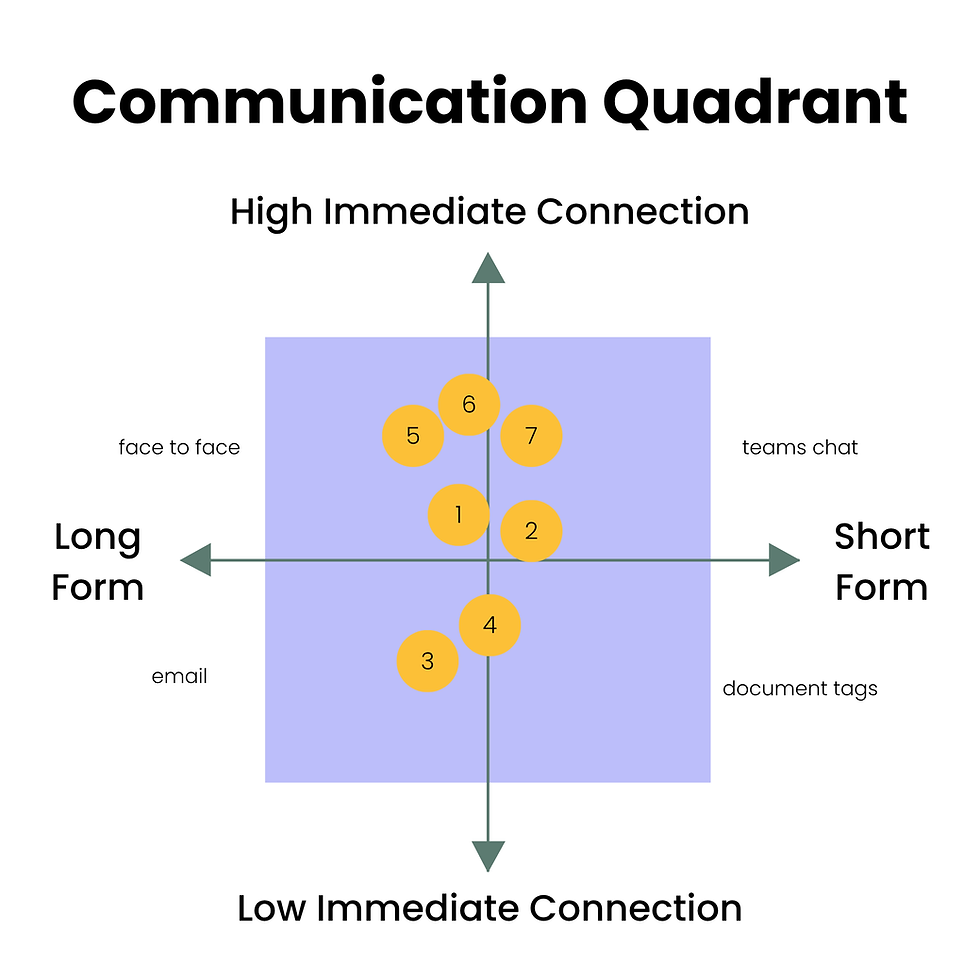
The Quadrant is a snapshot of where we are right now, with the understanding that “now” will keep changing.
Every communicator has a default channel. A library team, especially a split-schedule one, generates moments constantly where one person's default simply won't work all the time. This dissonance creates the need for a decision that happens outside a comfort zone. That practice of knowing your preferred channel well enough to consciously step outside of it when the moment calls for it is what I usually refer to as contextual flexing.
It helps to understand why defaults exist in the first place. The same Strengths themes that shape how someone approaches their work also influence how they prefer to communicate. A team member leading with Empathy or Developer may find themselves drawn naturally toward face-to-face conversation, where relational nuance can do real work. Someone leading with Deliberative or Intellection may feel most at home in email or documentation, where there is space to think before responding and where the communication itself can be considered and precise. A person with strong Achiever and Responsibility themes may need to say what they need to say before the moment passes, making high immediacy channels feel less like preference and more like necessity. And someone whose Strengths are oriented around Input, Context, and Learner may instinctively follow up an email with an in-person conversation because dialogue is how they make meaning out of information.
When I look at my team through this combined lens, what I see are two people who anchor low on the immediacy side, most comfortable with email and documentation as their primary channels. They are deliberate communicators who engage deeply when given the space to do so on their own terms. On the other side, several team members gravitate toward high immediacy connection, though not always interchangeably. One person is strongly face-to-face and finds digital stand-ins for that connection unconvincing. Another moves fluidly between in-person conversation and documentation, drawn to depth in whatever form it takes.
And then there is the pattern that the quadrant made most visible to me: when someone's preferred channel isn't part of the team's default communication flow, their silence can be misread as disengagement. It isn't really, though. It's a signal that the message didn't arrive in a language that landed. That realization alone makes this whole exercise worth doing.
As for me, I sit low on immediacy and somewhere in the middle on form, which means I'm probably more comfortable than I should be sending emails into the void and assuming they constitute connection. Something to keep in mind.
The Quadrant exists, but introducing a tool and actually integrating it are two different things. I'm somewhere in between. That in-between space is part of why I'm writing this. I don't think I'm doing anything revolutionary here. I just think I'm trying to solve a pretty common team problem of varied communication preferences.
If any of this resonates, ask yourself: what is your team assuming about how you communicate that has never been said out loud?
My next step is to formalize this into a mini case study, moving through six phases:
Re-examine our Strengths baseline
Run a pre-intervention survey across five leadership areas I care about most (Role Clarity, Mutual Trust, Communication, Recognition, and Team Synergy)
Introduce the Quadrant and encourage it as something the team actively uses
Collect qualitative and operational data along the way
Run a post-intervention survey
See if anything changes
I'll be framing this analysis through a Relational Leadership and Positive Psychology lens, which are the theories that most closely reflect how I'm trying to show up for this team.
For now, that feels like enough to keep going.
Further Reading
Clifton, J., & Harter, J. (2019). It's the Manager: Moving from Boss to Coach. Gallup Press.
Cota, M. (2024). Relational and Collaborative: Librarian Leadership. The Journal of Academic Librarianship. 50(2). https://doi.org/10.1016/j.acalib.2024.102848
Quinn, B. (2005). Enhancing Academic Library Performance through Positive Psychology. The Journal of Academic Librarianship. 42(1), 79-101. https://doi.org/10.1300/J111v42n01_05
Sharp, A. (2013). Cognitions, Emotions, and Applications: Participants' Experiences of Learning about Strengths in an Academic Library. The Journal of Academic Librarianship. https://doi.org/10.1016/J.ACALIB.2013.02.008
Comments